The Sixth Industrial Fluid Properties Simulation Challenge
Objective
The objective of this challenge is to test the ability of computer modeling to predict the mutual solubility in liquid-liquid equilibria of water and a glycol ether as a function of temperature.
Timeline
June 16, 2010: problem announced
** UPDATED ** October 22, 2010: entries due; to be submitted to contest@ifpsc.org
November 2010: champions announced at the AIChE annual meeting IFPSC session
Background
Unlike most organic solvents, glycol ethers and glycol diethers exhibit an “inverse solubility” relationship with water. That is, in the range of normal process conditions they become more compatible as they are cooled and are completely miscible below the lower critical solution temperature (LCST). This behavior is typically rationalized in terms of a temperature-dependent balance between hydrophobic and hydrophilic interactions. This balance of interactions in aqueous solutions is of great scientific and practical importance as a key driving force in phenomena like self-assembly and protein folding.
Glycol ethers are used in a wide range of product formulations and industrial processes. For example, they are used as solvents and co-solvents in both organic- and water-based formulations for applications such as cleaning solutions, paints, coatings, and inks. A variety of other novel applications have been proposed that take advantage of the inverse solubility behavior.
Dipropylene glycol dimethyl ether (DPGDME) is unique among common propylene-oxide-based solvents in that it has no hydroxyl functionality. This means it is relatively inert and can be used in systems that are proton-sensitive (e.g., water-based polyurethane coatings). Although mutual solubility data for liquid−liquid equilibrium (LLE) for a number of water + ethylene glycol ether and water + propylene glycol ether mixtures have been reported in the literature [1], the temperature-dependence of water + dipropylene glycol dimethyl ether mutual solubility has not been reported. Data are available at 298 K for the commercial product PROGLYDE DMM TM where the solubility of DPGDME in water is reported to be 35 wt % and of water in DPGDME to be 4.5 wt % [2].
Proglyde DMM (C8H18O3) consists of 3 structural isomers, two of which are the major components that occur in approximately equal amounts):
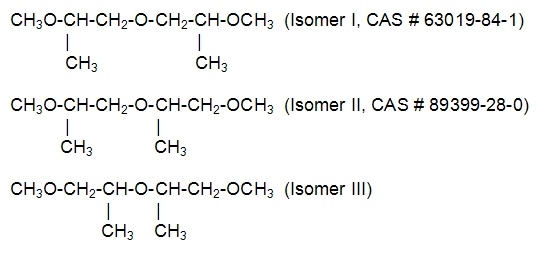
A typical composition of PROGYLDE DMM is 50 % I, 47 % II, and 3 % III. CAS # 111109-77-4 can represent any of the three isomers or mixtures thereof.
Studies of phase equilibria by molecular simulation have become relatively common, employing techniques such as Gibbs Ensemble Monte Carlo [3] and Grand Canonical Monte Carlo with histogram reweighting [4]. Typically, these methods have been employed to study vapor-liquid equilibria in particular and to develop general, transferable force fields (potential energy models) that are reasonably accurate over a wide range of state conditions. Only rarely have these methods been used to predict liquid-liquid equilibria of realistic, moderately complex molecular systems. More commonly, molecular dynamics simulations have been used to study liquid-liquid systems, but those studies have typically focused on the details of structure and interactions at the interface and not on predicting the bulk phase compositions of the coexisting phases. Therefore, assessing the capability of molecular simulation methods and force fields to accurately predict liquid-liquid phase equilibria for practically relevant and moderately complex chemical systems is of interest in establishing more clearly the state-of-the-art capability in this application area.
Challenge
For the PROGLYDE DMM + water system, compute the mutual solubilities in liquid-liquid equilibria at temperatures of 283, 323, 333 and 353 K and atmospheric pressure.
Rules of the Game
- Any theory/modeling/simulation method can be used. In keeping with the focus and goals of the IFPSC, molecular modeling and simulation methods are especially encouraged.
- Any force field (or other model parameterization) previously published in the open literature prior to the announcement of this challenge is acceptable.
- Force fields (or other models) that have not been published previously may not be parameterized for this challenge using mutual solubility data for the water + DPGDME system (except for the published data at 298 K). Force fields (or other models) may be parameterized using any other published physical property data.
- Estimates of the uncertainty for computed mutual solubilities must be included.
- Participants may choose to model PROGLYDE DMM as only one of its constituent isomers or as a mixture of isomers.
Challenge Scoring
Entries will be scored by comparing the predicted composition of each phase (wt % PROGLYDE DMM) to measured data. Full credit will be awarded for a prediction that falls within the experimental uncertainty. A linear interpolation of partial credit will be awarded for predictions with an absolute deviation above the minimum threshold and a maximum of X % (to be determined). No points will be awarded for prediction above the maximum deviation. Each of the four state points will be weighted equally (i.e. represent 25 % of the total points available).
Other Entry Guidelines
- Entries are to be submitted to contest@ifpsc.org on or before the deadline
- A submission for this challenge problem is to be in the form of a manuscript suitable for submission to a refereed, archival, scientific journal. The manuscript must contain sufficient detail about the simulation or other method and about the force field (if simulation) so that an experienced simulator could reproduce the results without requiring access to proprietary information. In particular, all potential parameters and molecule geometry parameters must be explicitly specified in the manuscript. The results are to be reported in SI units.
- An analysis of the uncertainty in the calculated results is required and must be included in the manuscript.
- Entries are expected to present results that are statistically significant and to present sufficient supporting evidence to establish this quality. Also, the scientific reasoning behind any new (unpublished) force field parameterizations must be clearly spelled out in the entry. If there is a consensus among the judges that an entry is of poor quality (uses a method commonly accepted to be fundamentally flawed, presents results that are not statistically significant, fails to provide sufficient supporting data and details, violates the various rules and guidelines established for the competition, or for any other reason would be unlikely to be accepted by any peer-reviewed scientific journal in the field), that entry will be rejected and will not be considered in the judging.
- Entries that represent collaborations between multiple research groups are welcomed.
References
[1] S.P. Christensen, F.A. Donate, T.C. Frank, R.J. LaTulip, L.C. Wilson, Mutual Solubility and Lower Critical Solution Temperature for Water + Glycol Ether Systems, J. Chem. Eng. Data, 50 (2005) 869-877.
[3] A.Z. Panagiotopoulos, Direct determination of phase coexistence properties of fluids by Monte Carlo simulation in a new ensemble, Mol. Phys., 61 (1987) 813-826.
[4] A.M. Ferrenberg, R.H. Swendsen, New Monte Carlo technique for studying phase transitions, Phys. Rev. Lett., 61 (1988) 2635-2638.
